
Medellin Factfile
Where is Medellin Located?
Colombia is located in the Northwestern corner of South America and shares it’s borders with Panama, Venezuela, Brazil, Peru and Ecuador. When viewing a map of Colombia, if you exclude the vast Amazon Rainforest in the south of the country, Medellin is situated directly in the middle of Colombia - equidistant between Bogota, Cali, Cartagena and Bucaramanga.
Medellin is located at the base of the Aburra Valley and surrounded by mountains. In recent years Medellin has outgrown its small enclavement and the city now joins Bello & Copacabana to the north and Envigado, Itagui and Sabaneta to the south.
The locals of Medellin are collectively referred to as “Paisas”. (The people from Bogota are called “Rolos” and those from the coast “Costeños”).
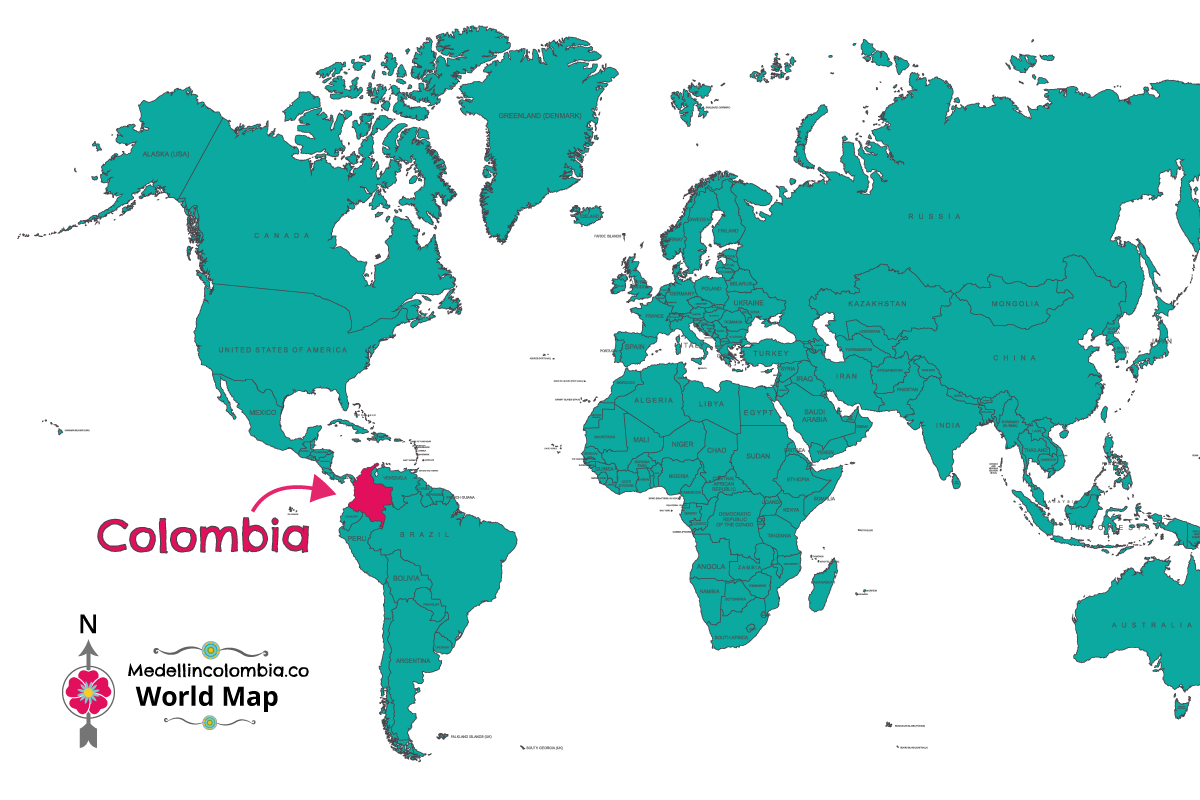
Colombia: The Gateway to South America
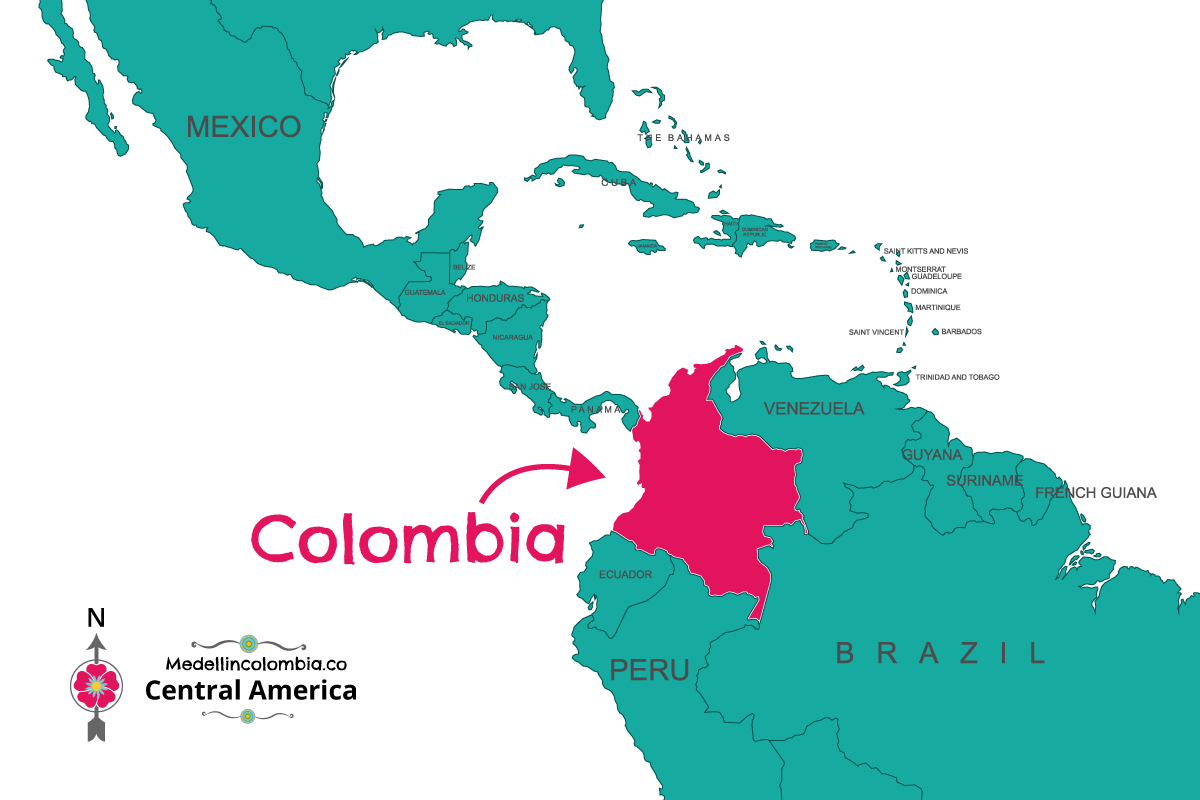
Colombia: A Nexus of Five Nations
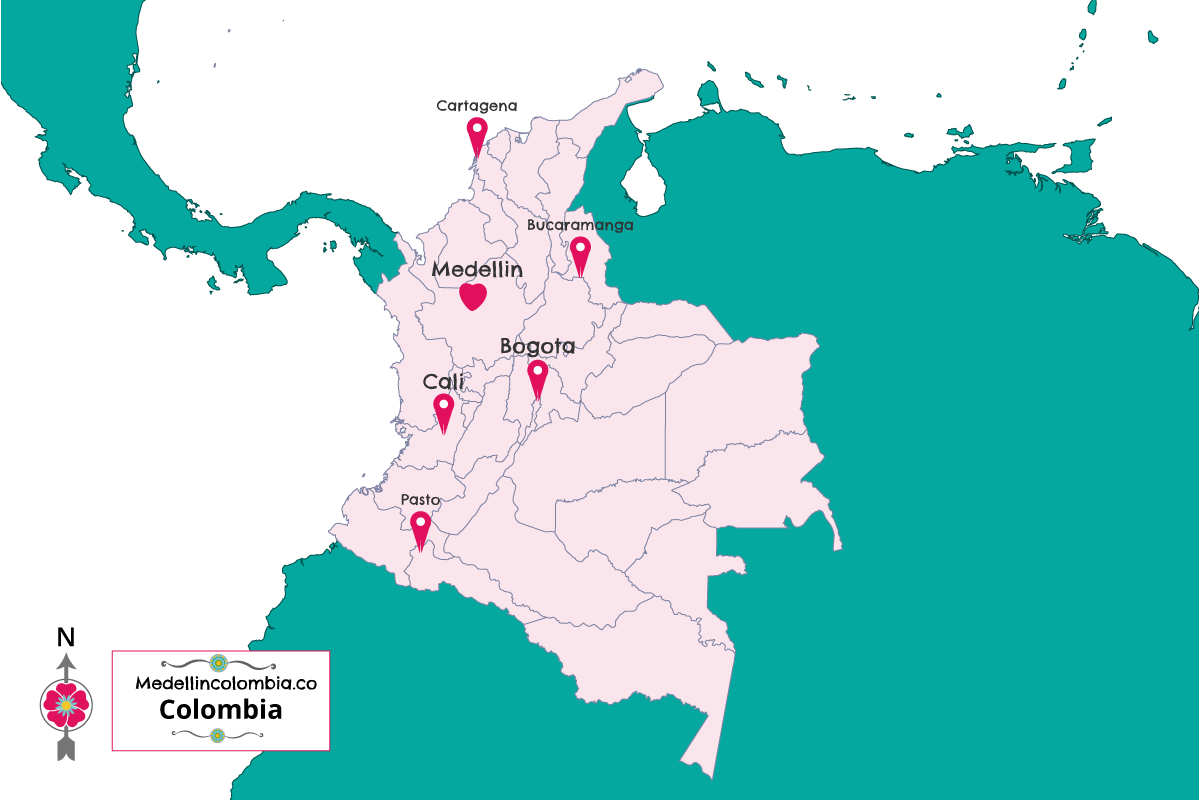
Medellín: Heart of the Andes
Medellin Map
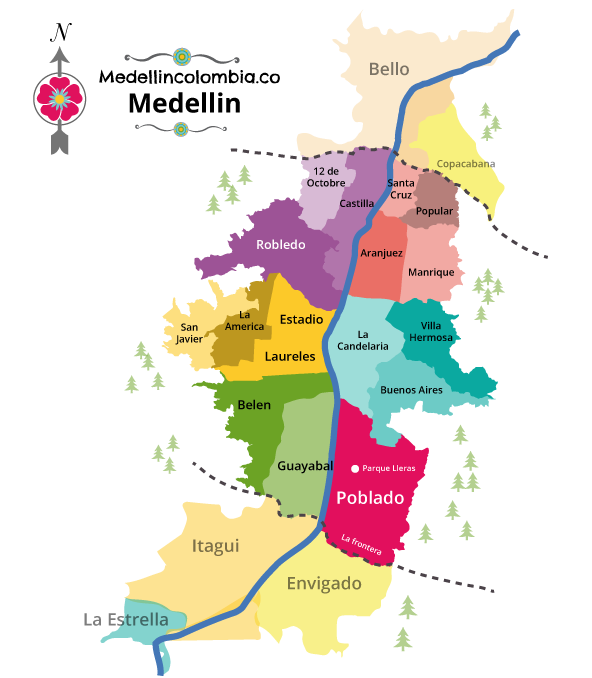
History of Medellin
Spaniards first discovered the Aburra Valley and some of it’s local inhabitants in the 1540’s. However Medellin was not founded by Spain until 1616 by Francisco de Herrera Campuzano, three quarters of a century later. Early development of Medellin began in what is modern day Poblado.
Medellin’s rapid growth came much later, around the beginning of the 20th century. The railroad and the boom in the profitable cash-crop, coffee, were the main catalysts for the cities expansion. Within a few short decades Medellin had become a bustling metropolitan city.
By the 1980’s, Medellin’s history took a turn for the worse. Political instability and drug trafficking took hold of the city. The notorious drug lord Pablo Escobar began to run the city of Medellin with the power that came from his exorbitant wealth, derived from the production of the world’s cocaine supply. At the time, the city’s homicide rate was one of the highest in the world. Escobar died in 1993 and the city has returned to much safer levels. With a homicide rate of 7.4 per 100,000 residents, much less than several major US cities, such as Baltimore and Detroit.
With the improved security status Medellin is now being touted as one of the top must-visit destinations by prestigious media such as National Geographic, The Guardian Newspaper and BBC news. With all this international hype Medellin is currently one of the fastest growing tourist and expatriate destinations in South America.
If you're a history buff and curious to see old photos of Medellin you might appreciate the following Facebook groups:
Population of Medellin
Medellin is Colombia's second largest city with a population of 2,427,129 people recorded at the most recent census in 2018 (Source: DANE: Departamento Administrativo Nacional de Estadística). The population of Medellin was expected to grow to 2,612,958 people in 2022 and reach 2,927,890 by 2030. Bogota, the capital, meanwhile has over 8 million residents.
The population by barrio at the 2018 census was as follows (Source: DANE):
| Belen | 202,931 |
| Robledo | 189,238 |
| Doce De Octubre | 177,190 |
| Manrique | 164,858 |
| San Javier | 157,243 |
| Buenos Aires | 155,391 |
| Villa Hermosa | 153,216 |
| Aranjuez | 141,312 |
| Popular | 136,986 |
| Castilla | 123,992 |
| San Cristóbal | 116,420 |
| Santa Cruz | 113,064 |
| El Poblado | 106,805 |
| Laureles - Estadio | 99,904 |
| San Antonio de Prado | 94,801 |
| La América | 85,416 |
| La Candelaria | 75,913 |
| Guayabal | 64,651 |
| Altavista | 38,856 |
| Santa Elena | 23,468 |
| San Sebastián De Palmitas | 5,474 |
| Total | 2,427,129 |
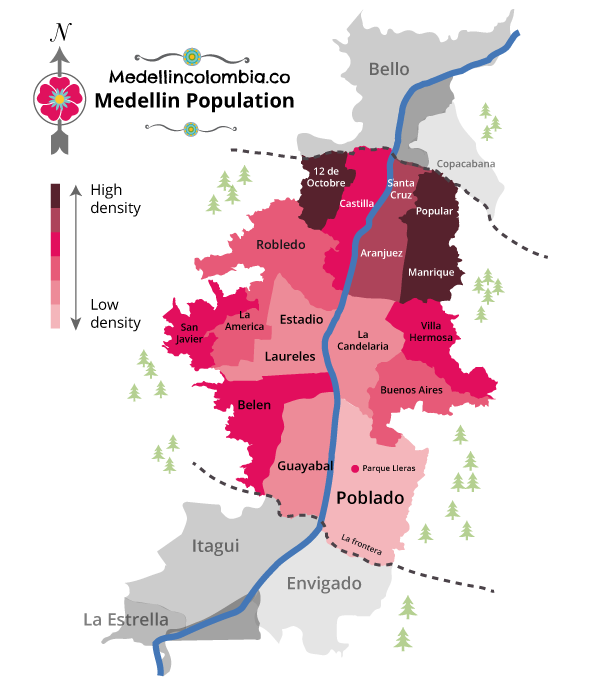
The following map is an "estimation" of the population density within the city of Medellin.
Medellin Tourism Figures
With Medellin's improvement in safety the level of both tourists and expats in Medellin is rising significantly.
Government statistics claim that Medellin is Colombia’s 2nd most popular city for tourism after Bogota and with Cartagena following behind. About 2.5 million tourists visit Colombia every year - up from 540,000 in 2002 when Colombia was still considered a fairly unsafe place to travel. Medellin saw 1,400,000 international visitors in 2022. About 20% of Medellin's tourists are from the United States, 16% from Europe (mostly Spain, Germany, France and UK) and a large proportion of the rest are Latin American travelers.
To give an example of the rapid growth of tourism in Medellin, pre 2010 there were only about 5 hostels catering to foreign tourists. That number however increased rapidly over the subsequent 10 years. By the beginning of 2020 the number of hostels had exceeded 150. Then the Covid-19 pandemic hit tourism very hard and a majority of the hostels were forced to close. Quite a few converted to webcam studios. Now post-pandemic hostels are springing up everywhere once again, especially in the Manila area. Whilst Provenza used to have the highest concentration of hostels in Medellin, it's now mostly a restaurant and nightlife zone.
Medellin’s expat community is also steadily rising. Whilst there is no official census it is estimated that the number of long term expats - including retirees, those working officially and those working unofficially (digital nomads etc) now exceeds 10,000 people.
Weather in Medellin
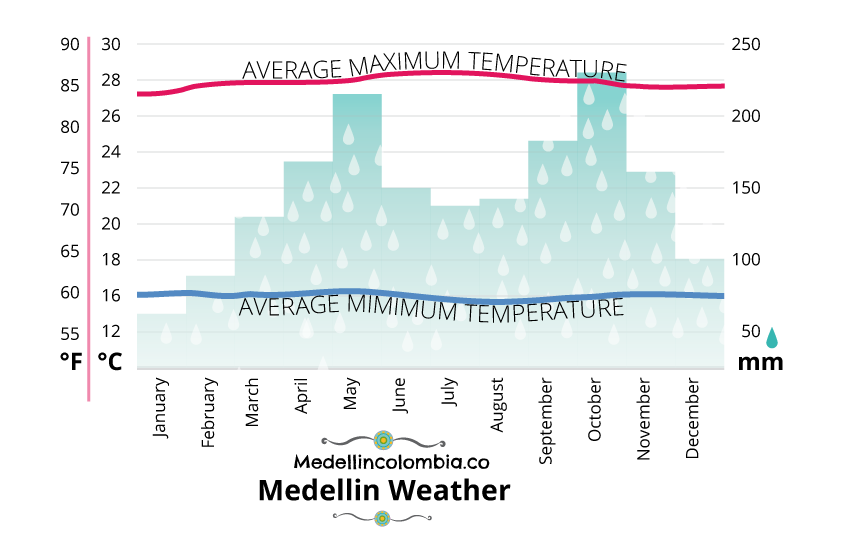
Medellin's location to the equator and higher elevation means that temperatures rarely fluctuate year-round, effectively achieving a constant “spring” feel. The ideal weather of Medellin is cited by nearly all local expats for being one of the main reasons they packed up and chose to live here.
Daily temperatures range from a minimum of about 16°C (63°F) to a maximum of 28°C (82°F). On a typical sunny day the temperature might be a couple of degrees higher and on a cloudy or rainy day the temperature might be a few degrees cooler. As you drive up the valley that surrounds Medellin the weather is noticeably cooler and a light jacket may be suitable.
On the subject of rain, many people ask “When is the rainy season of Medellin?” This is a difficult question to answer. This is mainly due to the weather of Medellin changing from year to year due to the El Niño & La Niña effect. Some years, Medellin may experience heavy umbrella breaking rains for weeks on end (during La Niña), while other years, the sun may be intense and constant with very little rain (during El Niño).
The only predictable factor is that the temperature is always comfortably warm.
Immunization
You do not need any particular type of travel immunization to travel to Medellin. Whilst there are mosquitoes here there is no need to take Malaria medication.
If you are planning on going to the Amazon rainforest, however, you should consider getting immunization shots 10 days prior to departure for the following diseases and ailments: Malaria, Hepatitis A, Typhoid, Yellow Fever, MMR, and Tetanus Diptheria. Before your trip, schedule an appointment with your personal physician to go over the details of the immunization of your trip. If you have any more questions or concerns, feel free to check out the website for the Centers for Disease Control & Prevention.
You do not require COVID-19 vaccination to enter Colombia.
Language
The official language of Colombia is Spanish. The second most common language is English, although not that widely spoken.
Whilst the government is currently pushing English language education in schools (many universities require students to study English) you may have trouble finding people on the street who speak conversational English.
In more affluent and tourist friendly neighborhoods, such as El Poblado, there will usually be someone at the hostel, hotel, bar, or restaurant that speaks English. It’s also common for menus to have an English description or English version altogether. Elsewhere, despite the language barrier the locals are friendly and will do their best to try and understand you. Body language goes along way.
If you're looking to learn Spanish in Medellin we recommend Toucan Spanish School.
Colombian Spanish
Colombian Spanish is supposed to be the purest and most neutral Spanish there is. This is why Colombia is often touted as the best place to learn Spanish in South America. It is spoken without the distinct lisp that is heard in Spain and is spoken at a slower pace making Colombia an excellent location for studying Spanish.
Let’s quickly review some noticeable differences in Spanish spoken in Colombia compared to other Spanish speaking countries.
The double “L” in Spanish from Spain or Mexico sounds like a “Y” (for example, “Medellin,” would sound like Me-De-Yeen). However, in Medellin, the double “L” is more of a “J” sound. For example, a Medellin local, a Paisa, would pronounce Medellin as Me-De-Jeen. If you go around saying Me-De-Yeen it’s an easy indication for locals to know that you’re a newbie in town.
To ask someone how they are in Spain you would ask “Cómo estás?” or “Qué tal?”. However, here in Colombia, it’s more common to ask “qué más?” or “bien o no?” when greeting others.
If you didn’t understand someone speaking, instead of asking “Qué?”, or “Mande?” in Mexican Spanish, it’s much more common to ask “Cómo?” in Colombia.
Terms for time have a slightly different meaning as well. In Spain “ahora” means “now”. However, in Colombia, this may mean “in a little bit” or even “much later”. If Colombians don’t want to do something now they’ll often say they’ll do it “ahora”, which may mean later or it might just be a convenient excuse not to do it.
When visiting restaurants or shops in Colombia, you’re also bound to hear “A la orden!”, which is to say, “At your service!”
“Pues” is also frequently spoken at the end of sentences. Oddly enough, it doesn’t really mean much.
"Parce" means "mate" and you'll hear this quite often.
You can take Spanish classes with Toucan Spanish School.